Updated September 24, 2026.
Guelph’s election is approaching, with decisions ahead on housing, taxes, transportation and municipal services. Here are the voting basics, the areas covered by each ward and a brief look at what candidates say they want to do.
The Voting Basics
- Election day: Monday, October 26, 2026. Polls are open from 10 a.m. to 8 p.m.
- Advance voting: October 10–18, with hours and locations varying by date.
- Who you can vote for: One mayor, up to two councillors in your ward, and school-board trustees according to your eligibility.
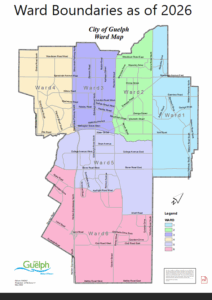
The summaries below highlight candidates’ stated priorities, rather than their complete platforms. Ward descriptions are general guides—not exact address boundaries. The City’s ward lookup can confirm where a particular address falls or the image below:
Mayor: Candidates for the Entire City
Leanne Caron
- Background: A current Ward 5 councillor who also works in management at the University of Guelph.
- Taxes, housing and services: Caron emphasizes tax stability through efficiencies, investment and additional revenue sources. She supports housing across different price ranges, more frequent and reliable transit, and infrastructure designed to withstand climate-related pressures.
- Accountability: Her proposals include a public council dashboard, regular town halls and newsletters. She wants council’s priorities and spending decisions to be communicated more clearly and connected to community feedback.
Ken Yee Chew
- Background: A current Ward 6 councillor and urban designer with public- and private-sector experience.
- Spending and services: Chew wants affordability targets established earlier in the budget process, with more consistent oversight throughout the year. He also emphasizes dependable basic services and easier navigation of planning and building approvals.
- How City Hall operates: He proposes focused standing committees for key municipal responsibilities and building more expertise within city staff rather than relying as heavily on outside consultants. He also supports closer coordination with Wellington County on housing and crisis-response services.
John Edward Krusky
- Background: A private investigator and security consultant who also ran for mayor in 2022.
- Spending and downtown: Krusky wants to reduce spending and remove aesthetic extras from downtown renewal while keeping necessary infrastructure repairs. He opposes adding more surveillance cameras.
- Other proposals: He suggests using the former Ontario Reformatory property for housing people experiencing homelessness, alongside employment opportunities. He also proposes eliminating the separate chief administrative officer position and taking on those responsibilities himself. These are proposed changes, not existing arrangements.
Ryan Meunier
- Background: Meunier highlights a 20-year teaching career in local schools.
- Budget approach: He proposes reviewing departmental budgets and operations for duplication and unnecessary costs. He also wants council salaries frozen for the full term.
- Service priorities: Roads, water, waste collection and emergency services come first in his platform. He supports preventive road maintenance, fewer barriers to housing construction, and transit improvements focused on frequency and useful connections. His approach emphasizes improving existing services before adding new commitments.
Evaristo Ramos Jr.
- Background: Ramos works in information technology and digital services and has been involved in community organizations, including DIYode.
- Housing proposal: He wants an arm’s-length, city-owned development corporation to build affordable housing on municipally owned land. The land would remain public through long-term leases rather than being sold.
- How he proposes to deliver it: His plan includes standardized modular construction, applications for provincial and federal financing, and nonprofit organizations or Wellington County operating completed housing. Rental income would help repay financing under his proposed model; its financial results are not independently verified here.
Rajee Sinha
- Background: Sinha highlights experience in real estate, hospitality, retail management and small business.
- Taxes and growth: He wants closer scrutiny of city-controlled spending, faster housing approvals and more business investment. His housing message centres on reducing unnecessary delays rather than establishing a public housing builder.
- Service and safety proposals: He supports published service standards, better tracking of residents’ requests and fewer transfers between departments. His public-safety approach combines enforcement with prevention and support services, including attention to property crime and public spaces.
Ward 1: East Guelph
General area: East of Victoria Road, including neighbourhoods around Eastview Road, Grange Road, Starwood Drive, Watson Parkway and the eastern York Road corridor. Two council seats.
Tammy Corbin
- Background: A factory worker and Ward 1 resident who grew up in Guelph. She says neighbourhood advocacy, including a petition for speed bumps, helped motivate her candidacy.
- Priorities: Corbin wants closer scrutiny of major municipal projects and their costs, including downtown renewal and the new library. She also emphasizes food and shelter needs, homelessness and safer neighbourhood streets. Her campaign connects household affordability with greater accountability for infrastructure spending.
Dan Gibson — Current Councillor
- Background: A Ward 1 councillor since 2014 and an environmental scientist working in hydroelectric generation.
- Priorities: Gibson emphasizes property-tax restraint and dependable essential services. His east-end priorities include completing York Road reconstruction on time and within budget, and advancing the approved mixed-use development around Starwood and Watson. He supports bringing more shopping, housing and employment opportunities to the east end, alongside neighbourhood traffic-safety improvements.
Daniel Kaufmann
- Background: A grocery-store front-end supervisor and tenant-union member who promises full-time availability for council work.
- Priorities: Kaufmann focuses on affordability, preventing infrastructure cost overruns and helping community groups obtain municipal support. On homelessness, he supports stable accommodation and rehabilitation services rather than repeatedly moving people between locations. He also supports growth when necessary services are planned in advance and green space receives protection.
Marcel Dion Lambert
- Background: A self-employed Ward 1 resident who says she wants stronger representation for people who feel overlooked by local government.
- Priorities: Lambert identifies property taxes, homelessness, food insecurity and everyday affordability as her central concerns. She emphasizes listening to renters, homeowners and people without housing. Her published questionnaire concentrates on these broad priorities; a specific tax target or detailed housing-delivery model is not established in the material reviewed here.
Owen Martens
- Background: A fence builder and University of Guelph political-science graduate whose experience includes waste-facility work and community volunteering.
- Priorities: Martens supports faster housing permits, increased housing supply and scrutiny of municipal spending. He proposes freezing councillor pay and improving everyday services, particularly road maintenance and snow clearing. His platform emphasizes practical service delivery alongside reducing approval barriers for people trying to build housing.
Evan Silva
- Housing and taxes: Silva supports lower residential property taxes and proposes allowing qualifying owner-occupied households with children to defer property-tax payments. A deferral would postpone payment rather than cancel the tax.
- Development and spending: He favours prioritizing core services and infrastructure over large discretionary projects. He also supports walkable, mixed-use neighbourhoods and measures aimed at corporate landowners holding undeveloped land. His housing approach combines tax-policy changes with changes to neighbourhood development.
Dave Williams
- Background: Williams highlights decades of working and community experience, including approximately 20 years representing co-workers.
- Priorities: He wants spending examined before taxes increase, while maintaining roads, transit, parks and recreation. Affordable housing and homelessness are also priorities. On development, he argues that housing growth should be accompanied by the infrastructure and services needed to support it, rather than treating construction targets separately from residents’ day-to-day needs.
Mustafa Zuberi
- Accountability: Zuberi proposes an annual review of council decisions to check whether they have actually been implemented. The emphasis is on tracking completed work, not simply recording approved motions.
- Growth and services: He supports commercial and industrial investment intended to create jobs and broaden the tax base. His priorities also include infrastructure, transportation and community safety, with development planning that considers groundwater, parkland and heritage protection.
Ward 2: North-Central Guelph and Parts of Downtown
General area: Includes Waverley Drive, Emma Street, Eramosa Road west of Victoria, Grange Street and the Elizabeth–Neeve area, extending into downtown. Two council seats.
Michael Barber
- Background: Owner of The Hive arts collective, with previous experience running a construction business.
- Priorities: Barber proposes a cabin- or shed-style community for people experiencing homelessness, with an emphasis on getting accommodation available before winter. He also wants better snow clearing, attention to existing roads and infrastructure, and more deliberate growth planning. On housing, he distinguishes between simply adding units and creating homes people can afford.
Michelle Bowman
- Background: An aquatic ecologist, educator and consultant who highlights experience working with rivers and national parks. She promises full-time availability as a councillor.
- Priorities: Bowman emphasizes affordable housing and food, community safety and climate preparedness. She supports energy retrofits, green employment, tree-canopy protection and biodiversity. Her platform treats household costs, environmental protection and community services as connected issues rather than separate municipal responsibilities.
Troy Bridgeman
- Background: A multimedia journalist and musician with approximately 30 years of journalism experience.
- Priorities: Bridgeman identifies affordability, groundwater protection and the influence of private technology companies as central concerns. He raises questions about artificial intelligence and surveillance and wants municipal decisions to protect public interests. He also favours a more cautious approach to growth that preserves established neighbourhoods, cultural activity, architecture, trails and natural spaces.
Greg Cox
- Background: Owner of CrossFit 1827 and a former freight-brokerage entrepreneur.
- Specific proposals: Cox supports a discounted downtown-worker parking-pass pilot, faster handling of straightforward permits, and published approval timelines that distinguish city delays from applicant delays. He also supports multi-year funding for Welcoming Streets outreach.
- Service approach: His platform combines downtown maintenance and safety measures with outreach, clearer municipal responsibilities and better public reporting on spending and service performance.
Morgan Dandie
- Housing: In a current candidate questionnaire, Dandie supports prioritizing housing with rents capped at 30 per cent of household income, particularly subsidized, accessible and deeply affordable units. Dandie also supports denser, walkable neighbourhoods near transit and services.
- Other commitments: The questionnaire records support for stronger green-development standards, round-the-clock shelter access, three meals daily for residents in need, and emergency community grants for food security and daytime support spaces.
Kim Fry
- Background: A teacher and climate organizer with experience working in municipal government.
- Specific proposals: Fry supports a publicly run grocery-store pilot and a public builder for deeply affordable, social and nonprofit housing. She also favours stronger tenant protections, fourplex-style infill and additional housing downtown.
- Transportation and environment: Her priorities include reliable transit, safer cycling and walking, building retrofits, groundwater protection and the national urban park proposal. She also supports mental-health and harm-reduction services.
Rodrigo Goller — Current Councillor
- Background: A current Ward 2 councillor with previous civil-service and small-business experience.
- Priorities: Goller supports municipally owned, permanently affordable rental and supportive housing. He also emphasizes traffic calming, infrastructure maintenance and coordination of emergency and social supports. His development approach directs more density toward downtown and major transportation corridors while protecting groundwater, trees and parkland. Housing ownership and long-term affordability are explicit parts of his platform.
Barbara Mann
- Bakcground: Lifelong Guelph resident and longtime community volunteer
- Priorities: Her municipal interests have included housing affordability, responsible development, environmental protection, transportation, public transit, active transportation, heritage and responsible management of taxpayer money.
Alec Purves
- Background: A downtown night auditor and block-security worker.
- Specific proposals: Purves wants a public washroom at Guelph Central Station, reforestation of the former IMICO industrial site and a permanent stage in St. George’s Square.
Spending and community support: He emphasizes scrutiny of municipal spending while also proposing investment in public amenities. He has pledged to donate most of his council salary to food banks and limit individual contributions to his campaign.
Ward 3: Central and Northwest-Central Guelph
General area: Includes neighbourhoods around Dawson Road, Edinburgh Road North, London Road West, Suffolk Street West, Paisley Street and Waterloo Avenue. Two council seats.
Phil Allt — Current Councillor
- Background: A current Ward 3 councillor and long-time Guelph resident.
- Priorities: Allt emphasizes groundwater protection, public safety and managing development within the city’s capacity. He also advocates changing how municipalities are funded, including seeking a greater share of provincial revenue, so local services depend less heavily on property taxes. His platform links the pace of growth with the financial and environmental resources needed to support it.
Kevin Bowman
- Background: A seasonal parks-and-recreation labourer with previous human-resources experience who brings a renter’s perspective to the race.
- Housing approach: Bowman supports moving existing purpose-built rental buildings into nonprofit or other non-market ownership, rather than relying only on new construction. He also identifies food insecurity, mental-health and addiction support as priorities. He promises full-time availability and supports growth planning that accounts for infrastructure and groundwater constraints.
Annika Maldonado
- Housing and affordability: Maldonado wants to explore targeted property-tax incentives for landlords providing below-market rentals, developers creating affordable housing and low-income households.
- Community support: She also emphasizes earlier mental-health and addiction intervention, including outreach before problems become crises. Her website presents the tax measures as ideas to explore; specific rates, eligibility rules and full costs are not established in the material reviewed for this guide.
Michele Richardson — Current Councillor
- Background: A first-term Ward 3 councillor seeking re-election.
- Priorities: Richardson wants closer control of spending, including scrutiny of externally funded boards and organizations, while expanding the range of housing available. She supports working with builders and other partners to remove development barriers. On safety, she favours combining policing with housing and social services rather than treating enforcement as the only response. Collaboration among councillors is another stated priority.
Marty Williams
- Background: A retired candidate who has lived in Guelph for approximately 40 years.
- Priorities: Williams supports housing across the income spectrum, dependable core services and closer spending oversight. He wants better use of existing city assets, including more concerts and events at the Sleeman Centre. He also supports examining service arrangements with Wellington County and giving councillors an earlier role in policy development, before proposals reach the final-decision stage.
Ward 4: West Guelph
General area: The west end, generally west of Silvercreek Parkway and north of the Speed River, around Elmira, Imperial, Willow, Westwood, Paisley and Fife roads. Two council seats.
Linda Busuttil — Current Councillor
- Background: A current Ward 4 councillor and volunteer general manager of the West Village Community Development Co-operative Charity.
- Priorities: Busuttil supports preserving existing lower-cost rentals and creating more public, supportive and community housing. She wants new development to include affordable, accessible and family-sized homes. Infrastructure maintenance, parks, trails and neighbourhood programs are also priorities, alongside community food initiatives and other supports delivered through local organizations.
Brendan Clark
- Background: A construction-company owner whose work includes residential renovations and basement apartments.
- Priorities: Clark proposes reviewing municipal programs and spending on outside organizations to identify duplication while protecting essential services. He wants growth matched with roads, parks, recreation and other infrastructure.
- Communication commitment: He promises to acknowledge residents’ inquiries within 24 hours, provide regular updates and explain his council votes. That is a response commitment, not a promise that every problem would be resolved within a day.
Jesse Guite
- Budget approach: Guite proposes reviewing spending line by line, with the goal of limiting property-tax pressure and directing resources toward essential services.
- Service priorities: Roads, underground infrastructure, park maintenance and safe school zones are central to his platform. He wants those needs prioritized over projects he considers unnecessary. His campaign also emphasizes resident input and responsiveness, rather than presenting a fixed list of major new municipal programs.
Ali Malik
- Background: A senior data analyst with experience at major grocery companies.
- Priorities: Malik supports better Ward 4 transit, expanded community facilities, additional recreation opportunities and affordable youth programming. He also wants commercial investment that creates jobs and broadens the municipal tax base.
- Accountability: His approach includes identifying clear project goals, timelines and results. He argues that development should be accompanied by sufficient infrastructure and services rather than leaving those needs to be addressed later.
Derek McCaughan
- Background: A retired municipal executive with 34 years of experience at the City of Guelph, including leadership responsibilities involving operations, transit and emergency services.
- Priorities: McCaughan emphasizes disciplined budgeting, infrastructure maintenance and dependable services. He supports spending restraint alongside investments considered necessary for the city’s longer-term needs. His growth approach connects housing and transportation with infrastructure capacity, and he emphasizes clear expectations and measurable results for municipal spending.
Ward 5: University and South-Central Guelph
General area: The University of Guelph, College Avenue–Stone Road area and neighbourhoods around Scottsdale Drive and Rickson Avenue, with the eastern portion extending toward Arkell Road. Two council seats.
Michael Agueci
- Background: A University of Guelph commerce student studying government, economics and management.
- Housing and transportation: Agueci supports allowing more homes on existing lots, concentrating housing near transit and shops, and creating walkable mixed-use neighbourhoods. He also proposes bike sharing.
- Local employment: He wants closer university-business connections to help graduates find careers in Guelph, including opportunities in agri-food, veterinary science and advanced manufacturing. His platform connects housing availability with retaining younger workers.
Xandine Arnott
- Background: Arnott has worked with small businesses and nonprofits, including managing the Guelph Tool Library’s Circular Store and assisting with the Guelph Farmers’ Market.
- Priorities: She emphasizes poverty prevention, reliable transit, safer roads and walkways, and protecting community resources. She also wants clearer public records of councillors’ votes. Her affordability approach focuses on the value residents receive from services, rather than promising tax reductions without identifying the accompanying service changes.
Greg Cawsey
- Background: A business-education and financial-literacy leader at John F. Ross CVI and a long-time Ward 5 resident.
- Priorities: Cawsey proposes keeping property-tax increases below inflation while maintaining services. He also emphasizes traffic, public safety and preserving the character of established neighbourhoods as development proceeds. Regular communication and helping residents obtain answers from City Hall are central to his campaign. His tax proposal concerns the pace of increases, not a blanket tax cut.
Dakota Cherry
- Background: A grant writer with public-policy experience and a master’s degree in food security.
- Food proposals: Cherry supports a city-run grocery store operating on a nonprofit model, a regional food hub connecting farms with buyers, and measures to reduce edible food waste.
- Council reform: She also proposes replacing two part-time councillors per ward with one full-time representative and introducing online voting. Those would be changes to future municipal arrangements, not the rules for this election.
Jon Christensen
- Background: Co-founder of Bidmii, owner of The Ten Spot and board chair of Hopewell Support Services.
- Priorities: Christensen emphasizes improving road and sidewalk maintenance, snow clearing, transit, and building and planning services. He wants easier interactions with City Hall and clearer measures of whether spending improves residents’ experiences. He points to his work with contractors, permits and a nonprofit providing supported housing as experience relevant to municipal service delivery.
James Doran
- Background: A research, innovation and economic-development consultant with experience working with municipalities, businesses and post-secondary institutions.
- Priorities: Doran emphasizes spending on essential services and infrastructure, attracting investment and supporting local businesses. He also wants to protect neighbourhood character, cultural activities and natural spaces. His platform calls for a clearer long-term direction for the city, with housing growth planned alongside water, transportation, recreation and employment needs.
Cathy Downer — Current Councillor
- Background: A current Ward 5 councillor who also highlights a background in mediation.
- Housing and growth: Downer wants the city to identify what is preventing approved housing projects from proceeding, work with builders on municipal barriers and advocate to other governments where necessary.
- Infrastructure and employment: She supports tying development approvals and timing to water capacity, investing in conservation and infrastructure, and implementing an employment-land strategy with stronger business and university involvement.
Wesley Harris
- Background: A registered veterinary technician with board, finance and governance experience through the Ontario Association for Veterinary Technicians.
- Priorities: Harris supports careful spending, protection of basic services and housing that working residents can afford. His public-safety approach includes properly funded policing, community supports and resources for crime victims. He also emphasizes representation for renters, homeowners and people experiencing homelessness, alongside development supported by appropriate infrastructure
Danny Lui
- Background: A retired pharmacist and small-business owner who also has experience in supportive housing and arts leadership.
- Priorities: Lui wants spending scrutinized without sacrificing core services. He supports additional housing when roads, transit, water and wastewater infrastructure are planned alongside it. On homelessness and community well-being, he favours better coordination among housing, health care, mental-health, addiction and community-support organizations. He also emphasizes communication and neighbourhood participation.
Dylan White
- Background: A wildlife biologist and small-business owner.
- Priorities: White supports stronger environmental standards for development, groundwater protection and services intended to reduce poverty. He favours additional density near major roads, transit and employment, with planning that considers environmental impacts.
- Public spaces: His priorities include a national urban park, libraries and accessible public spaces within new developments. Climate resilience and protection of natural resources are central to his platform.
Ward 6: South and Southwest Guelph
General area: Includes Kortright Hills, the Niska–Ptarmigan area, Clairfields and neighbourhoods around Clair Road, extending south to Maltby Road. Two council seats.
Rebecca Adam
- Background: A director of people and culture who lives in Kortright Hills and has long-standing ties to Ward 6.
- Priorities: Adam emphasizes spending discipline, community safety and public trust. She wants clearer expectations for accountability and communication at City Hall, alongside more direct engagement with residents about safety concerns. Her growth approach focuses on planning and collaboration to accommodate development, rather than treating whether growth will happen as the central debate.
Shane Coulis
- Background: A procurement executive who highlights experience reviewing budgets, negotiating requirements and identifying cost savings.
- Priorities: Coulis supports lower property taxes, stronger spending accountability and investment in essential infrastructure.
- Safety proposals: He wants stronger resident-police relationships and neighbourhood-watch participation. He also proposes considering predictive crime mapping to help determine where resources are deployed. That technology proposal is part of his platform, not an established outcome or independently assessed solution in this guide.
Luke Devos
- Background: A small-business owner and south-end resident.
- Spending and growth: Devos wants municipal programs assessed against their intended results and essential services prioritized. He supports distributing new housing more broadly across Guelph rather than concentrating development in the south end.
- Permitting: He proposes clearer approval timelines, better progress updates and a single point of contact for residents and builders. He also wants access, sidewalks and parking considered before developments are built.
Katherine Hauser — Current Councillor
- Background: A current Ward 6 councillor, former school-board trustee and University of Guelph employee who also serves on the university’s board of governors.
- Priorities: Hauser supports housing growth matched with infrastructure, services and recreation. She wants efficiencies while protecting essential services, and stronger advocacy when provincial decisions shift costs locally. Accessible public spaces, community partnerships, homelessness, mental health and food insecurity are also priorities. Her stated approach emphasizes collaboration across organizations.
Helen Liu
- Background: A bookkeeper with payroll and tax-preparation experience who has lived in Guelph for more than two decades.
- Priorities: Liu wants housing to be less expensive to buy or rent, more employment opportunities and a welcoming community. She also highlights her international and immigration experience. Her published profile outlines those goals but does not set out detailed housing incentives, a specific tax target or a costed municipal program.
Laura McQuillen
- Background: A teacher and Westminster Woods resident.
- Priorities: McQuillen emphasizes affordability, efficient services and growth supported by parks, infrastructure and community amenities. She identifies parking, traffic and road safety as neighbourhood concerns, and wants better connections for walking, cycling and driving. Her approach also includes more resident involvement in development decisions and attention to lower-income households when municipal costs and service decisions are considered.
School-Board Candidates
School-board choices depend on the board a voter qualifies to support. These are the candidate names; the policy summaries above cover mayor and council.
Upper Grand — Wards 1 and 5: Aaron Blair, Bill Foster and Martha MacNeil.
Upper Grand — Wards 2, 3 and 4: Dan Atkinson, Randy Freese, Lange Frosst and Ralf Mesenbrink.
Upper Grand — Ward 6 and Puslinch: Pallavi Ramchandani and Kyle Reaburn.
Wellington Catholic — Guelph: Natalia Crewson, Vikki Dupuis, Valerie Fayer, Marino Gazzola and Holly Sabara.
Rachid Barrima, for Conseil scolaire Viamonde, and Genevieve Grenier, for Conseil scolaire catholique MonAvenir, are listed as acclaimed.